
For decades, a flagship showroom on the streets of Clerkenwell has been the calling card of any serious contract interiors brand. A street-level presence in London's design quarter signals credibility to architects and interior designers, gives products a physical stage, and anchors a brand's relationship with the specification community. But it has also always come at a price — one of the highest per-square-foot costs in the capital, plus the ongoing overhead of staffing, utilities, business rates, security and maintenance.
In an economic climate defined by tighter budgets, cautious capital expenditure and a construction sector that has been slow to regain its footing, that price tag is harder to justify than ever. Against this backdrop, a new model is emerging in Clerkenwell — and it has just had its first major outing.
Lammhults and Tarkett
Tarkett, whose Tarkett Atelier on St John Street has become one of the district's most distinctive showroom with it's brands 'Tarkett, Desso, and Stellar by Tarkett'.
It is now sharing that space with the brands of Lammhults Design Group — Abstracta, Fora Form, Lammhults and Ragnars — who moved in to coincide with Clerkenwell Design Week.
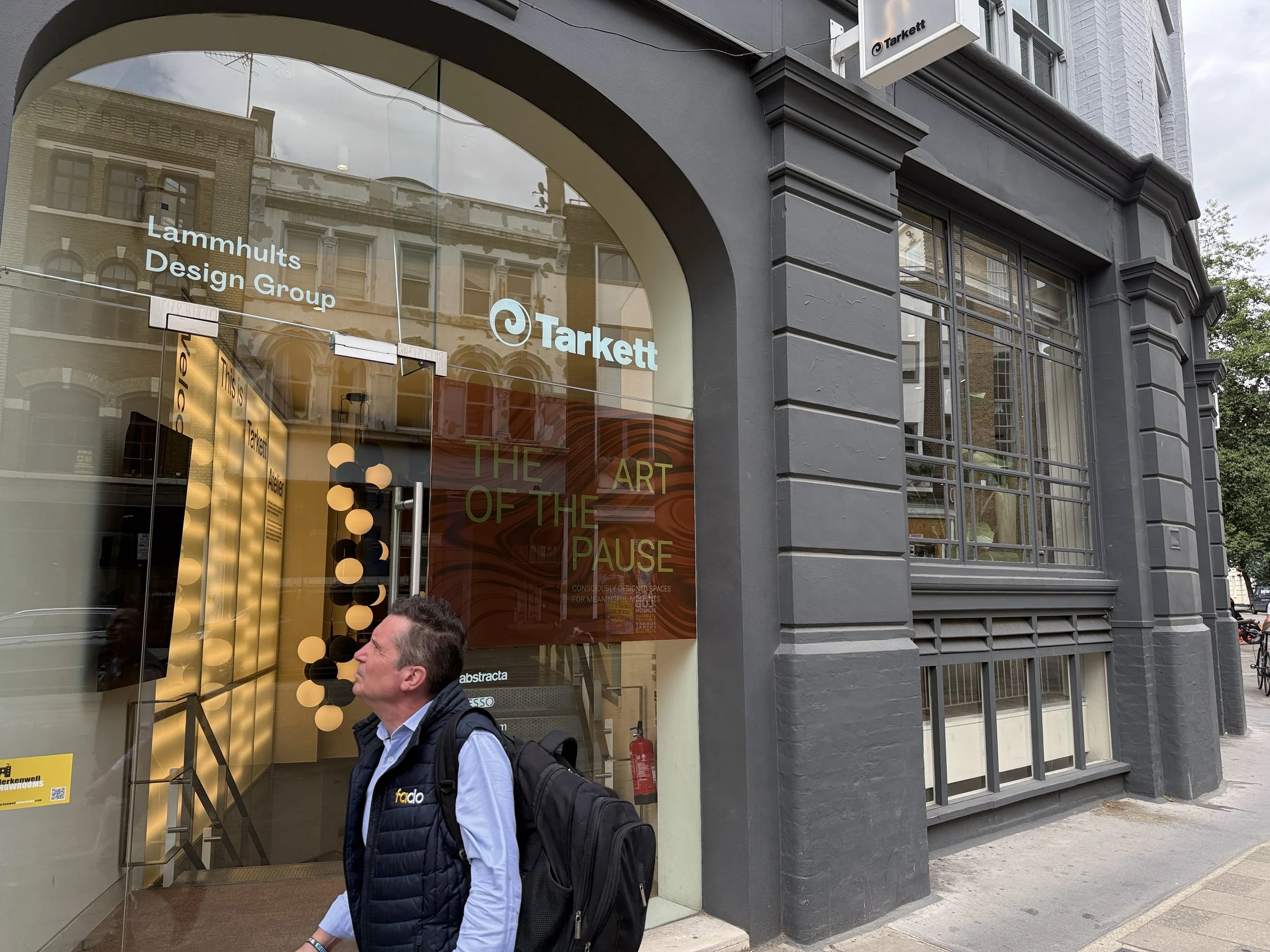
The arrangement was brokered by Clerkenwell Showrooms (CS), the not-for-profit social enterprise set up to support and grow the district's showroom community, and it's being described as the first major sharing arrangement of its kind in London. It's worth looking at why this matters, and why it might be a template rather than a one-off.
The cost case: halving overhead without halving presence
The economics are straightforward. A shared showroom means two (or more) brands splitting rent, rates, utilities, cleaning, security and front-of-house staffing across a single footprint. For manufacturers weighing up whether a Clerkenwell address is still affordable, that changes the calculation considerably — a prestigious location that might be out of reach for one brand on its own becomes viable when shared with a complementary partner.
This is precisely the kind of structure CS's Property Services arm exists to facilitate: matching showrooms and exhibitors, and helping negotiate the practicalities of shared occupation. In an uncertain economy, where many manufacturers are under pressure to justify every line of fixed cost, that brokerage role — finding the right partner, on the right terms — is what turns "sharing a showroom" from a nice idea into something that actually happens.
The footfall case: one visit, two (or more) reasons to come
Flooring and furniture are natural showroom companions rather than competitors, and that's no accident. A specifier visiting Tarkett's flooring collections now finds themselves a few steps from Scandinavian furniture and acoustic solutions from across the Lammhults Design Group portfolio — and vice versa. Each brand effectively gains exposure to the other's visitor base, without either having to do more marketing to earn it.
This cross-pollination effect compounds with CS's wider programme of activity — CS Open events, specifier tours, the CDW yellow flag scheme, and the district-wide notice board and WhatsApp news channel all exist to funnel visitors toward member showrooms. A shared space with a richer, more varied offer is simply a more compelling stop on any of those organised routes. As more brands take up sharing arrangements, the effect should scale: Clerkenwell becomes not just a collection of individual showrooms, but a denser, more interconnected destination where one visit can cover multiple categories — reinforcing its position as Europe's largest district for contract showrooms, furniture and materials exhibitors.
The sustainability case: walking the talk, not just stocking it
Both businesses involved already build sustainability into their product stories;
Tarkett Atelier was designed around circular collections and recyclable materials, with the brand's take-back scheme feeding directly into its sourcing
Lammhults Design Group's brands are built on durability and long-life design as a deliberate alternative to disposability. A shared showroom extends that thinking from the products on display to the way the brands themselves operate.
One fit-out instead of two means less embodied carbon spent on construction, finishes and materials that ultimately serve the same purpose. One set of building services — heating, lighting, cooling — means a smaller combined operational footprint per brand than two separate spaces would require. For specifiers who increasingly ask not just "is this product sustainable?" but "does this company practise what it preaches?", a visible, voluntary sharing arrangement is a tangible answer. It's a sustainability credential that doesn't require a product spec sheet to communicate.
Setting a precedent for the district
What makes this arrangement notable isn't just that it happened, but what it signals. CS's stated mission — uniting the Clerkenwell showroom community, increasing visitor numbers and efficiencies, and reducing showroom costs through shared property services — has, with this deal, moved from aspiration to proof of concept. The pairing of a flooring specialist with a furniture and acoustics group is a logical first pairing, but the same logic extends to plenty of other complementary categories: lighting and ceilings, fabrics and seating, surfaces and joinery.
For manufacturers currently weighing up whether to retreat from Clerkenwell altogether as costs bite, sharing offers a third option — neither full retreat nor full-cost presence, but a way to stay visible, stay central, and stay connected to the specification community while bringing overheads back under control.
A model worth watching
Cost-sharing, increased footfall and a credible sustainability story rarely align this neatly. The Tarkett and Lammhults Design Group arrangement, brokered through Clerkenwell Showrooms, gives the district — and the wider contract interiors sector — a working example of how shared space can do all three at once. In an economic environment where every line of expenditure is under scrutiny, that's not just a feel-good story about neighbourly collaboration. It's a genuinely practical case for rethinking what a showroom presence in London's design quarter needs to look like, and who it needs to belong to.